
It’s a Tour de France of two halves, as no-one says. British-born Irishman Ben Healy’s in yellow for the halftime oranges, having already achieved a full race’s worth of breakaway success.
- Stages 1-10
- Stages 11-15
- Stages 16-21

It’s not a great era for Team Breakaway, the informal and ever-changing team that forms on the road each morning with the shared mad goal of getting to the finish before the peloton.
Previous Tour de France winners, such as Chris Froome, were often happy to let a group of non-threatening riders get a few minutes ahead and contest the stage win among themselves. These days, either Tadej Pogacar sets his team to work chasing them, because he fancies the win himself, or Jonas Vingegaard asks his men to ride hard because they have this wild notion that the Dane can withstand a hard race better than his great rival.
Throw in a few sprint teams for the flat days and breakaway opportunities are few and far between.
So what do you do?
If you’re EF Education-Easypost, you go for it anyway, and ideally you do so with Ben Healy in the mix.

Step 1 involves convincing Tadej and Jonas that you aren’t going to steal the Tour de France from them. While Healy has been on the podium in hilly one-day classics, he doesn’t have much of a record competing in stage races, so that’s a reassurance in itself. He then shed three minutes or so in the Stage 5 time trial. From that point, he was seen as acceptable break fodder.
Step 2 involves targeting a day when the break might just stay away. These are typically days with a large number of climbs. On flat days, the bunch moves too quickly and when there are only one or two showpiece mountains, the overall contenders tend to be going full speed for too long. What you want is a climb early on to help you get away and tough roads throughout.
Step 3 is the hard bit. That involves actually getting into the break, working with your temporary allies for as long as it’s mutually beneficial and then picking the right moment to break those alliances. Also – small point – but you need to be a ferociously strong rider to accomplish all of that.
Stage 6 was the first of this year’s Tour that really stood out as a possibility: six categorised climbs with countless uncategorised ones in between. This resulted in the first two hours being undertaken at breakneck pace as everyone tried to execute the exact same plan.
The end result was that the eventual breakaway group comprised only riders who’d been able to withstand all of this. For the next hour-and-a-bit they all worked together to put some distance between themselves and the peloton. Then, with 40-odd kilometres to go, Healy set off on a nondescript stretch of road and the cohesion among the others ebbed sufficiently that he was never caught.

One stage win is a successful Tour de France if you’re a breakaway rider, but Healy again tried his luck across the eight classified climbs of Stage 10. At a certain point, while still accompanied by rivals, he realised his deficit to race leader Pogacar had been negated.
‘Why not try to lead the Tour de France for a bit?’ he thought. And so that’s what he set out to do, riding hard to retain his time advantage with few thoughts of conserving energy to contest the stage win (because leading overall is the bigger prize).

That decision was great news for his companions, even if it didn’t perhaps feel like it. Lenny Martinez, who is currently leading the King of the Mountains competition, rode so hard he developed a nose bleed. Apparently that’s a thing that can happen. What a sport.
Further ahead, demonstrating admirable nasal resilience, was this year’s Giro d’Italia winner Simon Yates, who had got in the break having already wilfully ceded 20-minutes to the main contenders to prove he had no designs on competing for the overall. Yates did his thing of biding his time and keeping a low profile before making the decisive move.
Will Ben Healy win the Tour de France?
Nope. Next week Healy will be repeatedly fighting to lead the Tour de France for one more day. That is a fine old goal and it’ll be fascinating to watch, but he will not be fighting to be the victor at the end of the three weeks. His best result thus far has been 27th, last year, almost two hours adrift.
At the same time, there’s always that proviso that we don’t really know what he’s capable of, because he’s never really tried to race every single stage before. Suddenly he has a reason to do so and now we’ll discover his limits – clearly, painfully and unequivocally.
You get this scenario every once in a while and it’s always very interesting. Thomas Voeckler was a breakaway specialist who got sucked into competing for the overall in 2011 after finishing second from the break on Stage 9. He held onto the lead through the Pyrenees and deep into the Alps and eventually finished fourth overall.
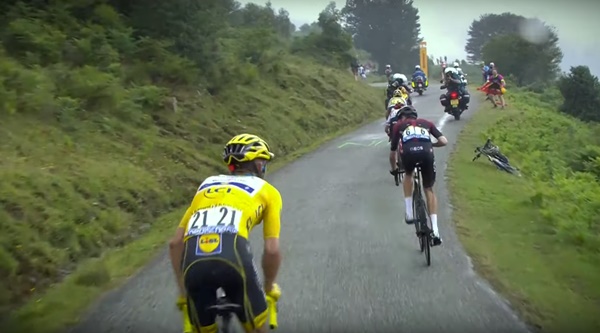
More recently, Julian Alaphilippe twice took the race lead in the 2019 Tour and fought hard to retain it over terrain that didn’t suit him. One of the fastest hill riders of the last decade, the Frenchman has never quite been able to hang with the best on longer mountain passes, but here he was forced to try. One day he was dropped but caught up again by descending like a lunatic. The next day you could see the effort, but it was all for naught. He finished fifth overall.
You don’t win the Tour de France like this, but by The Hammer of Thor Hushovd you can earn a lot of admiration. Good luck to Ben Healy for the (short) week ahead.
So who will win the Tour de France?
I’d love to offer you some intrigue; I’d love to float some additional contenders; but as things stand, it’s looking very much like Pogacar v Vingegaard again – same as it is every year.

That’s not bad though. At least there’s some doubt about which of them will win. We don’t always have that. The hilly terrain thus far has suited Pogacar far more than Vingegaard, whose major triumphs have tended to come on huge mountains, yet the Dane has not been meaningfully distanced (except in the time trial, where he unexpectedly surrendered over a minute).
He should find that encouraging given…
What’s next?
Bastille Day landing on a Monday means the first rest day was delayed so the first ‘week’ of this Tour actually extended to 10 days. That’s almost half the race. The second half will however be veeeeery different.
The most protracted climbs so far have been about 5km long and required not much more than a 10-minute effort. On Saturday, something much like that will be the easiest of four climbs, the most sizeable of which will be the Tourmalet (19km at 7.4%).
Before then, the riders will frolic through the vineyards on Wednesday (Stage 11), tackling a few short steep climbs. Thursday brings the first summit finish up Hautacam, where Vingegaard dropped Pogacar in 2022. Friday is a cronoscalata – a time trial to Peyragudes that’s roughly 600m of up in 10km of along.
The week finishes with some mid mountains on Stage 15, but there aren’t too many climbs in the closing kilometres, so that might actually be a quiet one with regards to the overall.
If you’d like to thank me for my Tour de France coverage, please do buy me a coffee or a Belgian beer – I love those things.
If you’re new to the site, please sign up to get these recaps by email.
Leave a Reply