

You can’t tell the story of Simon Yates’ 2025 Giro d’Italia win without first telling the story of Stage 19 of the 2018 Giro. That particular story began on Stage 6.
- Stages 1-9
- Stages 10-15
- Stages 16-21
On that day, scaling Mount Etna, Yates rode away from all the other favourites and took the race lead. Three days later, on another summit finish, he gained a few more seconds.
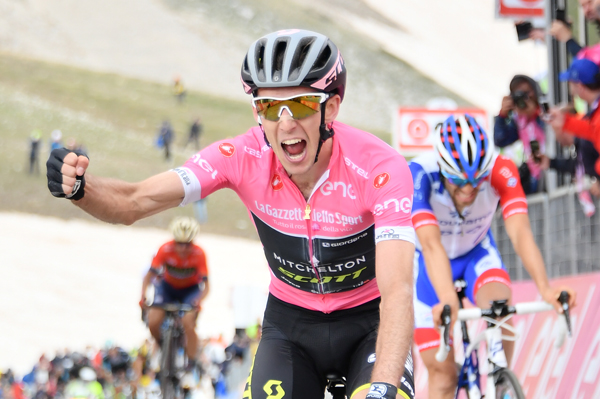
Early the next week, he won a hilly stage, and at the end of it took a third stage win to give himself a two minute buffer going into the final week. You know how the final week of the Giro can be though and you also know that in 2018 Simon Yates did not win .
That year the final week brought three successive summit finishes. Yates had proven himself the strongest climber, so if anything this seemed an opportunity to extend his lead. But this is the thing about the Giro. You can race for seconds over the first two weeks, but then suddenly the cumulative fatigue bites and riders start shipping minutes – or even tens of minutes.
On Stage 18 Yates showed signs of tiredness and lost a few seconds from his lead. Stage 19 brought the Colle delle Finestre. While everyone remembers Chris Froome winning the race that day, it’s worth dwelling on exactly how Yates lost it, which was bit by bit by oh-bloody-hell.

The Finestre is a brute of a climb. For one thing it takes an hour, which is very unusual for the pros. The lower slopes are steep; the middle part brings a comical number of hairpin bends, which are liable to tease you out of your rhythm; and then just to put the top hat on things, the surface turns to gravel towards the top.
Yates had attacked often in the first two weeks and then the time trial that began the final week had really taken it out of him. He’d used a lot of energy. There was no chance to recover. Matter was beginning to decline the endless and wearying instructions doled out by mind. After doing a passable impression of a Giro contender on Stage 18, his body gave up the pretence and surrendered 39 minutes.
Imagine that. After almost three weeks, you’re in the pink jersey and when you cross the finish line, you’re half-an-hour down. The results say it was a six-hour ride, but it’s easy to imagine how his perception of time would have twisted. The Finestre alone must have felt longer.
That’s the kind of experience that would stay with you. If you were Simon Yates and you saw the route for the 2025 Giro d’Italia with the Colle delle Finestre on Stage 20, you might think to yourself something like, “You know what, I’m not going to do too much sprinting for time bonuses in the first two and a half weeks. I think I’m going to try to keep just a little in reserve for that fiendish pigdog.”
The fiendish pigdog
All these allusions to needing to pace oneself and conserve energy might seem a little old fashioned in this era of riders dominating Grand Tours from start to finish, so let’s have a few quick facts.
Last year they went easy on the riders in a (succesful) bid to tempt Tadej Pogacar into taking part. The entire Giro route often brings in excess of 50,000m of climbing, but this dropped to 43,000m for 2024. This year, that was back up over 52,000m (with an extra 100km of distance thrown in for good measure).
That is a fair bit more tiring. Almost 25 per cent more climbing is highly likely to show in the final week – particularly the day after a stage that served up five climbs and 4,950m of elevation gain.

That stage – Stage 19 – finished with all the main contenders reduced to much the same steady-slog-to-the-finish pace. It was pretty obvious that someone was going to have an unhappy day on the Finestre the following afternoon. That person was not Simon Yates.
2019 Giro winner Richard Carapaz felt like he was in the best form and set about trying to drop Isaac del Toro at the foot of the climb, ordering his team to ride at a silly, unsustainable speed to make everyone unhappy.
This was partly successful. Everyone was definitely unhappy and del Toro was momentarily dropped, but Carapaz couldn’t create any serious distance.
In particular, he couldn’t create enough distance that Yates couldn’t calmly ride back up to the two of them a little way further up the climb. Then, having spent a couple of weeks conspicuously failing to attack and with no further mountain stages to come, Yates went on the offensive.

Who knows what energy his conservative riding up until then had saved him, but he had enough to deploy that one of those attacks eventually stuck.
Much has been made of the subsequent inaction of del Toro and Carapaz and how they repeatedly invited each other to chase, but honestly, they’d already chased a few times; it’s a long race – I think they were just cooked.
Yates had a 1m40s advantage over the top with only the gradual climb up to Sestriere to come. In that situation, there’s worse team-mates to have waiting for you up ahead than Wout van Aert.
Yates started the day 1m20s behind and finished it 4m ahead.
You can keep your bonus seconds.

What’s next?
The Critérium du Dauphiné starts next week and brings an abrupt cast change with Tadej Pogacar, Jonas Vingegaard and Remco Evenepoel all due to be in action ahead of their Tour de France tilts.
Highlights of the race will be on ITV4, so I’ll be watching (if not reporting) on it, simply because there are only so many more chances to watch ITV cycling coverage with the rights having been whisked away from them for 2026 onwards. (All respect to the game efforts of everyone involved in the TNT Sports production, but I am genuinely pretty down about this development. The ITV show is inimitable and unsurpassed. More on this subject later in the year.)
If you want my Tour de France recaps to arrive in your inbox, sign up for the email and I’ll make sure that happens.
And if you’d like to thank me for my Giro coverage these last few weeks, please do buy me a coffee or a Belgian beer – I love those things.
Leave a Reply